
Lock It In
July 6, 2025
In this encouraging message, Pastor Nicole teaches from Joshua 3–4, showing why God calls His people to remember — to “lock it in” — the great things He has done. Using the story of the Israelites crossing the Jordan River, she explains how God asked them to place 12 stones as a memorial so future generations would remember His power and faithfulness. As the priests stepped into the floodwaters, the river stopped — but only after their obedience. Pastor Nicole reminds us that like the Israelites, we are prone to forget God’s goodness. She points to Deuteronomy 4:9, Psalm 77:11, and Psalm 78:4, showing how scripture repeatedly calls God’s people to remember His mighty deeds, pass faith to the next generation, and recognize that obedience unlocks miracles. This message is a powerful reminder that remembering what God has done builds confidence for future challenges. Whether you’re facing hardship, prayer delays, or doubt, God’s faithfulness remains. Today’s story is a fresh invitation to recall God’s provision and live in the assurance that He will do it again.
Talk-It-Out
Icebreaker
Share a specific moment in your life when you clearly saw God’s help, provision, or presence. How did you think about that moment later?
Discussion Questions
- Remember God’s Faithfulness
Why is remembering God’s past goodness important for your faith today? How does it affect your confidence when facing future struggles? - Obedience Precedes Miracles
In Joshua 3, the river didn’t stop until the priests stepped in. What is one area where God may be calling you to take a step of obedience today? - Passing Faith to the Next Generation
How can your story of God’s goodness influence the next generation? What are practical ways you can share this with your kids, nieces/nephews, or younger Christians? - Internal Memory vs. External Reminder
Why did God tell the Israelites to build a memorial? What tangible or personal “stone” could help you remember what God has done?
This Week’s Action Step
Pick one moment of God’s goodness from your life and write it down. Place it somewhere you will see daily — a stone on your desk, a note in your Bible, a photo on your wall — and use it as a reminder to “lock in” God’s faithfulness.
Pray with someone this week and share your story of God’s provision to encourage them.
Key Scriptures
Deuteronomy 4:9 — Remember the Lord’s deeds and commands
Joshua 3:15–17 — The people cross the Jordan on dry ground
Joshua 4:6–7 — Stones to remind future generations
Psalm 77:11 — “I will remember the deeds of the Lord”
Psalm 78:4 — “Tell the next generation…”
Romans 10:9 — Salvation prayer (reference in message)
View Transcript
All summer we’re diving into the stories of the Bible and I’m excited to share a story with you today from the Old Testament. And before I do, I thought it would be appropriate for us to just think back. You know, sometimes when we are looking at stories in the Bible, we can feel like they’re so far removed from anything we experience in life today. And I want to encourage you because in 2012, culture around the world shifted forever.
And you might be thinking, “What is she doing with this?” Well, this is what changed the world forever. Technology introduced this device. And it meant that people no longer had to work at remembering.
Now, for some of you who are boomers and Gen Xers like me, we used to have to remember a lot of things like facts. We had to know things. We had to remember dates. We had to remember phone numbers. Okay. Now, here’s the thing. I can remember my home phone number when I was a child. But if you ask me about my kids’ phone number, I have no idea how to call my children right now.
We had to remember directions. There was no Google Maps. There was no Waze. There’s no Apple Maps. There was—and for some of you, remember MapQuest? Yes, we used to have something called MapQuest. And you could print out a map that you saw on your computer and take that printed map with you and it gave you turn-by-turn directions.
So there’s no more phone books, no more need for printed maps, no need to go to the library and use an encyclopedia. And for those of you who are really young, we actually used to have to go to a place called the library and we had to go to this library and we had to look up in the card catalog—there was this wooden box that smelled like old musty books and you had to go and find—you had to use the number system, the Dewey Decimal System—and you had to look it up. You had to go find in the card catalog where the book was on the shelf.
And when I was in college, there were two libraries opposite each other. And I had to go into the deepest, darkest crevices of Washington State University library. And I thought, “Someone could kill me back here and no one would ever know.”
The world now expects on-demand access to knowledge. But the thing is, we don’t demand of ourselves to remember any of it.
The invention of the smartphone created what analysts now call digital amnesia. And that’s the tendency to forget information that’s easily available via smartphones. And I know I’m not the only parent that doesn’t know their kids’ phone numbers because they did a study and 82% of parents can’t recall their children’s phone number from a smartphone.
The average person checks their phone 144 times a day, but you often can’t recall what you read from the day before, even in your Bible app.
So today’s struggle with memory isn’t new to humanity. By the way, the story that I’m going to share with you was written 3,000 years ago, and it shows us why God wants his people to remember. So turn to your neighbor right now and say, “Lock it in. Lock it in.”
That’s right. God has always been concerned about our forgetfulness and it’s frequently addressed in the Bible. The Israelites, for example, are often reminded not to forget the Lord’s deeds and commands. Listen to what he says in Deuteronomy 4:9. Let me get this right.
By the way, the title of my message is **Lock It In**. If you haven’t gotten there, go ahead. You can write that down for those of you who are taking notes, which I highly encourage since we can’t remember anything that this thing tells us.
Okay, let me read this to you. Deuteronomy 4:9. Remember, it’s frequently addressed in the Bible about forgetfulness. And the Israelites are often reminded not to forget. And here’s what it sounds like:
“Only be careful and watch yourselves closely so that you do not forget”—somebody say, “Do not forget”—”the things your eyes have seen or let them fade from your heart as long as you live.”
So we may have smartphones today, but creating something to help us remember is not new. God has been doing this since the beginning. God has always given his people something to do, like an action step to take or created something that helped them remember.
So our story today is found in Joshua chapters 3 and 4. And I’m going to dive right in because we’re reading about the Israelites. These are the people that God chose to have a close relationship with. Now, he gave them a special job to show the world who he is and how much he cares.
So we’re going to pick up on the story of what’s going on with the Israelites in Joshua chapter 3. So if you have your Bibles or your smartphone, you can look on the Bible app. And if you don’t have one of those, I recommend you download YouVersion—incredible Bible app. And we’re going to turn to Joshua chapter 3.
But let me give you some backstory. So Israel, God’s chosen people, have become enslaved in Egypt. Okay? So they were there and God rescued them. And because they were disobedient and did not honor God’s ways, Israel wandered in the wilderness for 40 years. In other words, when he rescued them from Egypt, he said, “I have a promised land for you, and I want to take you there, and it’s an 11-day journey.” By the way, it took them 40 years to get there.
Don’t nudge the person next to you if they struggle with directions like the Israelites did. Okay? It wasn’t just because they didn’t have Google Maps, okay? It was because they were disobedient. It’s because God let them stay in that desert for 40 years believing that they would learn the lessons they need to learn so he can move them on to the promised land.
So Moses, their leader, has now died. Joshua is now the new leader. And God tells Joshua, “Okay, it’s finally time for them to leave the desert and to go into the promised land.”
Okay, so we’re going to start reading in Joshua chapter 3. Says here, “So the people left their camp to cross the Jordan, and the priests who were carrying the ark of the covenant went ahead of them.”
Now, pause. The ark of the covenant is a constructed—like box. Box is the best way I know how to say it. A wooden box that was very ornate. And the ark of the covenant represented God’s presence with them. In other words, his spirit was within the box, the ark. And that spirit, as long as it was with them, they had specific rules about how close they could get to it, but that indicated that God was with them.
So what does he do? He says, “I want me, God, and the ark to go ahead of the rest of the people.”
So verse 15: “It was the harvest season and the Jordan was overflowing its banks. But as soon as the feet of the priests who were carrying the ark touched the water at the river’s edge, the water above that point began backing up a great distance away at a town called Adam, which is near Zarethan. And the water below that point flowed onto the Dead Sea until the riverbed was dry. Then all the people crossed over near the town of Jericho. Meanwhile, the priests who were carrying the ark of the Lord’s covenant stood on dry ground in the middle of the riverbed as the people passed by. They waited there until the whole nation of Israel had crossed the Jordan on dry ground.”
Scholars estimate there were two million people that day that crossed the Jordan River. Can you imagine being the priest holding up the ark in the dry riverbed? Those guys must have had some kind of biceps is all I’m thinking. They worked out or something. CrossFitters. They were the CrossFitters of the Israelites.
Okay, let’s go on to Joshua 4:
“When all the people had crossed the Jordan, the Lord said to Joshua, ‘Now choose twelve men, one from each tribe, and tell them, “Take twelve stones from the very place where the priests are standing in the middle of the Jordan. Carry them out and pile them up at the place where you will camp tonight.”‘”
Shout out to all of our campers.
“So Joshua called together the twelve men he had chosen, one from each of the tribes of Israel, and he told them, ‘Go into the middle of the Jordan in front of the ark of the Lord your God. Each of you must pick up one stone and carry it out on your shoulder, twelve stones in all, one for each of the twelve tribes of Israel. We will use these stones to build a memorial. In the future, your children will ask you, “What do these stones mean?” Then you can tell them. They remind us that the Jordan River stopped flowing when the ark of the Lord’s covenant went across. These stones will stand as a memorial among the people of Israel forever.’ So the men did as Joshua had commanded them. They took twelve stones from the middle of the Jordan River, one for each tribe, just as the Lord had told Joshua, and they carried them to the place where they camped for the night and constructed the memorial there.”
What happened? God asked them to build a memorial. God says, “I want you to have a memory out of these stones.” Why? Because I do not want you to forget who I am. Amen. I do not want you to forget what I have done for you.
And I’m going to give you three reasons that God wanted them to lock it in when it came to what he had done for them. Are you ready for this?
## The first thing you can write down is to remember God’s power and faithfulness.
Why the stones? Why remember? He wanted them to remember his faithfulness. And here’s the thing. We tell ourselves that when God shows up big in our life, we’re going to never forget it. But we do. And we’re not the only ones. Many of the stories in scripture point out how quickly humans forget.
Consider Elijah. He was a prophet in the Old Testament. And God used him to perform incredible miracles. When he had no food, God sent ravens to him. When he prayed for a drought, it happened for three years. At one point in his ministry, he prayed for a little boy who was dead to come back to life. And he did. Think about the miracles God did with him. I think I would remember if God used me to bring a dead child back to life. Just saying.
And then as if all of those things were incredible, Elijah asked God to do the unthinkable. He is wanting to prove to the people of the day that his God was greater than their God. And so he called down fire from heaven to consume a water-drenched sacrifice and prove that the Lord’s power over Baal was greater. And he ticked off Queen Jezebel because not only did the fire come down from heaven and consume everything on the altar, it killed her prophets too. She was mad.
Now, if I was Elijah, I’d have been like, “I don’t care if some woman’s mad at me. God has allowed me to take care of a drought. He fed me with ravens. I’ve healed a little boy who was dead. And I just saw him send fire down from heaven.” And you know what Elijah did? He ran.
A woman was mad at him named Jezebel. And he ran exhausted, afraid for his life. He ran and ran and fled into the wilderness. And he prayed that he might die.
Now, before you judge him, you all do the same thing. I think about this. How many times have you been through a fiery situation and God shows up for you and he rescues you and five minutes later you’re like, “I don’t know how I’m going to pay my bills this month.”
We think we would never do it, but we do. We forget the goodness of the Lord. And God doesn’t want us to forget. God wants us to remember. God wants us to remember that he was good. And we wonder sometimes where he is. And we wonder why he hasn’t answered our prayers. And sometimes it’s just our emotions. Sometimes it’s our own fear and our worry that gets the best of us. And sometimes it’s our disappointment. Sometimes it’s not that we’re running from a crazy lady that wants to kill us. Sometimes we’re asking, “Man, if he really loved me, why am I facing another struggle?”
And we doubt his power and his faithfulness to help us once again. And I’m here to encourage you because over and over and over again in scripture, we are reminded to remember, to lock it in that Psalm 77:11 says, “I will remember the deeds of the Lord. Yes, I will remember your miracles of long ago.”
That’s our part. God’s done his part. He’s created the miracle-working power. He says, “I’m almighty.” He says he’s going to take care of us. And it’s our part to remember. Why? Because we need to know that the next time we face something, he’s going to be there for us. Amen.
In Joshua 3, God showed up for the Israelites exactly when they needed him. He stopped the Jordan River. Could you imagine looking upriver? Could you imagine seeing a dry bed? Could you imagine the wall of water that was created? He wanted them to remember his mighty works because he knew a day was coming when they were going to need his power again.
The stones were meant to lock in that God is mighty and powerful and nothing is too hard for him. Why don’t you turn to your neighbor next to you and say, “He’s powerful.” Turn to the next neighbor. Say, “He’s faithful.” Turn to the other neighbor again. “He will do it again.” Tell them, “He will do it again.” That’s it.
## Another reason that God told them to lock it in was to pass their faith to the next generation.
He said in Joshua 4:6-7, “When your children ask, tell them.”
The stones were a visual reminder that God intended to provoke wonder. The curiosity of the next generation would prompt the telling of the story of God’s faithfulness and goodness. And every person in this room, online, in every one of our locations is passing on a legacy to the next generation. Every one of you are doing that. And something will be said of your life and how you lived it. And you don’t have to be a parent to pass down your faith legacy. You may be the auntie or uncle or friend.
But I really want to challenge parents today. God expects you to pass your faith down to the next generation.
A well-known preacher named Jonathan Edwards passed his faith onto his children in the 1700s. He was living in the American colonies and he became a well-known preacher and theologian because he sparked the First Great Awakening, which was a massive revival among the colonies. And he was a devoted father of 11 children. Hello. Some of y’all are freaking out with your two or three. This guy had 11.
His spiritual legacy was passed down to his family and he and his wife Sarah regularly prayed with their children and instilled strong Christian values. And their faith didn’t end with them. It carried on through their family line. And it influenced culture, education, and government through generations.
Listen to this. A study was done of his descendants. And here’s what they found. Over a hundred of his descendants became pastors and missionaries. Thirteen of them became college presidents. Sixty of them were authors. Three of them became US senators. And one of them was a US vice president.
You can’t possibly know what the generations in your family will do with their life, but you can make sure they know what God has done for you.
What if the greatest call in your life is to pour into the next generation? What if it’s to raise up a mighty woman, a mighty man of God who will go on to do incredible things on behalf of the kingdom? What if your greatest contribution to the kingdom is to serve in our church kids ministry? Oh boy, here we go.
Our kids at Champion Center deserve the best. They deserve to experience healthy, strong men and women that are leading the way as role models in their classrooms. And I just want to say thank you to every person who serves in our church kids ministry because you are raising up the next generation.
You’re investing in the future strength of our children and the future of our church. See, the future strength of Israel, it was dependent on the children knowing what God had done to deliver them. He delivered them from bondage. He brought them through the wilderness and he gave them the promised land.
And I wish I could stand here today and tell you that they did what God asked them to do all the time and passed it on to the next generation, but they didn’t. And sadly, many generations of God’s people, they didn’t tell their children about him, about his mighty works, about how he brought them through the fire, so to speak. And their children didn’t choose to follow him.
It only takes one generation to break the chain, to forfeit the importance of God in the lives of their family. But I got good news. It only takes one generation to break the chain of darkness. And if you’re in the room today and maybe you’re saying, “Nicole, I didn’t have that. I didn’t have anybody ahead of me. I’m the first in my family to ever serve Christ,” we applaud you today because you are beginning a new legacy, a new foundation, and you’re going to tell your children about the goodness of God.
Psalm 78:4 says, “We will not hide these truths from our children. We will tell the next generation about the glorious deeds of the Lord, about his power and his mighty wonders.”
Are you telling the next generation about your stories? Some of you are holding back because you’re ashamed. You don’t want your kids to know about the things you’ve done in the past. And I’m not suggesting they have to know about everything. But I think they should know how God brought you through. I think they should know how God delivered you. I think they should know about his blessings and how he cared for you. I think they should know when you were in your most hopeless state that he showed up and his presence comforted you and reminded you that you weren’t alone.
At the very least, tell them about the goodness of God and his presence in your life. Turn to somebody and say, “Tell them.”
## Number three, the final reason that God wanted them to lock it in—number three is to remember our obedience unlocks miracles.
Amen.
Joshua 3, remember we read the story. It says, “As soon as the priests who carried the ark reached the Jordan and their feet touched the water’s edge, the water from upstream stopped flowing.”
So only after they stepped in the water did the water stop flowing. Think about this. God can do whatever he wants. He could decide when he wanted that water to stop. He could have stopped the river first, but he chose to act in response to their faith in action.
And this teaches us that obedience often precedes God’s provision. He’s waiting for us to take action on the things he said he would already do for us.
Faith isn’t just belief. It’s movement.
The priests had to risk looking foolish. They had to risk getting wet or even getting swept away. Remember, we read that the waters were during the harvest season and it was flooding. We saw even this last week the terrible flooding that happened in Texas. And God, we pray for all of those who were lost and the families that are suffering. And we know how risky it is to be in flood-enriched waters. But because they trusted God’s word, they experienced a miracle.
A couple weeks ago, we had youth camp and we had several leaders that were praying over our kids. And Pastor John had asked God to use him to speak to our youth during youth camp. And as he was walking down the aisles asking God, “Lord, who do you want me to pray for?” He felt a nudge from God to go speak to a girl. He walked over to her and he said, “I feel like I need to tell you that God’s name is El Roi, which means he is the God that sees me.”
He said, “As soon as the words left his mouth, that young girl crumbled and fell and began weeping.” So he prayed over her, she got up and she shared with him. And she said, “Pastor John, I had written in my journal before camp that I didn’t think that God saw me.” She said, “I asked him to show me that he saw me because I didn’t want to live anymore.” And hearing from him at camp was my last hope.
She went on to tell him that she was planning on taking her life the following week of camp if God didn’t show up in her life. And Pastor John’s willingness to walk in obedience, to feel a nudge from God, to take a risk and speak something to this little girl unlocked a miracle for her. And that’s how God works with our obedience.
I think we can do better than that. God used him.
God speaks through nudges like that. It’s the Holy Spirit within us that is speaking and reminding us and telling us. Sometimes it sounds like just a little whisper. You see a person sitting by the door, homeless, potentially in need, definitely. And you feel the Holy Spirit say, “I need you to talk to that person.” Sometimes all you need to do is say, “I just want you to know that I feel like God spoke to me to tell you that he loves you and he sees you.” Sometimes we don’t even say it is of God. Sometimes we just need to act in obedience and smile. Sometimes it’s buying them a sandwich.
Whatever it is, God speaks through nudges. He speaks to us most often though through his word. He gives us direction in the Bible. He gives us wisdom to live our life his way. And like the Jordan River, sometimes we’re going to face impossible situations that make it really hard to obey God’s word. Like forgiving someone when they don’t deserve it, like doing sex and marriage God’s way.
I’m just going to let that one sit for a minute.
Like letting go of control and releasing anxiety to him. Like trusting God with our finances and tithing even when money’s tight.
Maybe the river you’re facing in your life feels like it’s at flood stage. And I just want to encourage you today. Remember, God is a miracle-working God and he shows up when we feel like we can’t keep our head above water. Is there anyone in this room that would say, “He’s done that for me?”
Romans 15:13 tells us, it says, “May the God of hope fill you with all joy and peace as you trust in him so that you may overflow with hope by the power of the Holy Spirit.”
Obedience unlocks miracles. Why don’t you turn to your neighbor and say, “Obedience unlocks miracles.” Obedience. Tell them to lock it in.
There it is. Lock it in.
God wanted his people to lock it in. Those stones that he gave them were more than just rocks. They were a reminder, a teaching tool, a symbol of his faithfulness. He is faithful and present in our lives. No matter what is happening, it’s our job to remember that our obedience makes a way for his miracles. And we’re responsible to pass on to the next generation what he’s done for us.
Our ushers are moving in all of our campuses right now. And they are passing out stones to you. You’re going to leave here today with a stone smaller than this, but thankful for our ushers. It’s going to get a little noisy and crazy in here. But here’s the thing. I wanted to give you something to remind you of today’s story. I didn’t want to just tell you to lock it in. I wanted you to have something physical to remember his goodness.
Because here’s the thing. After reading this story, I sat down and began writing down key moments in my life when God did miracles. Moments when God healed me, moments when he encouraged me, moments when he provided for me.
I love it. I hear the stones. I don’t know what’s happening at the other campuses, but here in Tacoma, I’m hearing the stones being passed all throughout the space.
I have several stones up here and they’re reminders to me of what God has done for me.
The first stone I want to tell you about is the stone where God helped me overcome insecurity. When I was in the third grade, a little girl threatened to beat me up on the playground. I know, you know, when you’re in the third grade, that’s a really big deal. And I was so scared of her that I hid when all the kids ran out to recess. I hid right under the door and the windows. And I sat by the door at every recess of my third grade year because I was afraid of her.
And one day, Mrs. Banks, my third grade teacher, she must have sensed something was off. And she came and found me outside at that door. And she invited me in. She let me erase the board. It was a big deal because it was chalkboard. That’s how old Gen X is. And I got to go outside and take the erasers and smack them together to release all the chalk so that she had a nice clean board.
And I didn’t know it at the time, but Mrs. Banks was a Christian and she was pouring life into me. And she created for me a model. And I believe today that Mrs. Banks was a part of the reason why I became a school teacher.
There’s a stone of God’s goodness in my life. I remember that when I was facing becoming a teacher. I remember that there was a professor who accused me of being a racist. And I remember that God brought women to surround me that had influence. And he lined them up. And those women helped me defeat that baseless accusation. One after another, God made sure that what he put in my heart to do—to be a teacher—he made sure it came to pass. Even when the enemy tried to stop it, I got a stone.
I remember in 2007 after the loss of our business and our home and my husband and I found ourselves with no jobs, no home. We weren’t sure what we were going to do to feed our family. And God showed up. The last place I wanted to come was here. I was embarrassed. I was ashamed. What were we going to do? And I remember two men at two different times came up to us. And the first one came up to us and he said, “I don’t know what’s going on in your world. But I felt like—but God told me I needed to give you this.” And he handed us a check for $5,000. And that $5,000 sustained our family until Eric and I could get a job. And he didn’t just do it once, he did it twice. God was faithful. I remember his faithfulness.
The stone here represents legacy. I remember when I met Ron and Maureen Freeman. The Freemans are sitting today in the Tacoma Auditorium. And I remember when she shared with me about raising her children here and growing up. I remember seeing their faithfulness to God. They have been here at Champion Center for 48 years in the same church.
Today is Ron’s 88th birthday. Happy birthday, Ron. Love you.
Ron and Maureen, to this day, they still serve in the house of God. They come in and help wherever it’s needed. And you reminded me that I’m never too old to do great things for God. Thank you, Ron and Maureen.
Thank you. You may be seated if you’re standing.
I have so many more rocks and so many more moments when I cried out to God and he heard me and he answered me. And I just want you to consider the stone that you’re holding.
What are the Jordan rivers that God has brought you through? When has he helped you? When has he rescued you or changed you? Pivotal moments where you wondered if he was there and was the trial ever going to end and then he provided a way. Moments when he kept you and sustained you and saw you through to the other side of pain that you thought was unbearable. Maybe he used a person to show you kindness on a tough day. Maybe your debt was mysteriously paid, your student loans forgiven. Some of y’all believing this is going to be the stone right now. “God help us with the student loans.” Or maybe you got the promotion over people who are far more qualified than you.
Write it down.
I hope that you leave here today and ponder and think about what are the ways that God has been good to me. Make it visible. It doesn’t have to be a stone. Some of you are real creative. You can find some other thing that represents God’s goodness, but put something in your airspace that reminds you.
The song we sang today speaks of remembering. The first line that was sung said, “I remember how you provided, how you held me through the night. I remember how you sustained me when you stepped in to save my life. And if I knew then what I know now, I would be still and let you work it out.”
And I promise you, there’s going to come another fire to endure. Another moment in life when you can’t see how it’s going to work out. Another moment when you feel like you’re going to be tossed into the water of life.
And if you will remember what he has done for you in the past, you can have the confidence of Psalm 46. And Psalm 46 says, “Be still and know that I am God. Lock it in.”
God wants to carry you. He wants to provide for you. He wants to love you. Some of you don’t even love yourself right now. And he’s saying to you, “I want to love you.”
And if you’re in the middle of a difficult season and you’re thinking, “I don’t know if I have any stones,” I promise you, he’s going to get you to the other side. I can’t promise you he’ll do it the way you think it should be done. But he’s faithful, and he’s just, and he’s righteous, and he is always on time.
I believe he’s here today drawing you closer to himself because that’s what he does. And so for some of you, today is your day to choose to follow him. Maybe the stone in your life starts today. And you say, “I don’t want to live another day without his love. I don’t want to live another day without his guidance. I don’t want to live another day without his provision. I don’t want to live another day without his power.”
And today’s the day you pick up your first stone of remembrance.
If you want a new beginning in your life with God, will you let me pray with you? If everybody would bow their heads across all of our locations.
Will you boldly, if that’s you, and you say, “I want that. I want a new start. I want a new relationship with God. I want to be the one who can tell the generations after me about his mighty power and his goodness. How he helped me walk through the floodwaters of my life. I want to be the one to tell them that when I was going through the fire, he was enough for me.”
I know that you’re probably wondering, “What does it mean to even follow him?” Don’t worry about that. That’s what your church family is for. We’re going to help you on your way. But if today you would say, “It’s my day for a new beginning,” would you boldly lift your hand all across this room?
I can see hands going up immediately all across the room here in Tacoma. Thank you, God, for every hand that’s raised, every hand that’s willing to say yes to you this morning.
Lord, God, we thank you here in Tacoma, in Bellevue, in DuPont, in Yakima, online. God, I’m going to lead you in a prayer. For those of you who’ve raised your hand, I’m going to lead you in a prayer. It’s a simple prayer. And this prayer is just simply going to ask God to forgive you of sin. Ask him to be the leader and Lord of your life.
Romans 10:9 says that if we believe in our heart and we confess with our mouth that Jesus Christ died and rose again, we’re saved. That all who call upon the name of the Lord would be saved. So as an act of solidarity, I’m going to say a prayer and I’m going to ask you to repeat after me and everyone in this room is going to join in because we’ve prayed that prayer and we know it’s the best decision that we’ve ever made.
So if you would just repeat after me and say:
“Lord Jesus, welcome to my world. Welcome to my world. Today, I ask you—today forgive me of all of my sin. I invite you to be the leader and the Lord of my life. And I boldly declare that I will never be the same again, in Jesus’ name.”
And everybody shout a great big amen.
Can we welcome everyone to the family of God this morning?

July 27, 2025
Causing Good Trouble
Getting in trouble usually feels like something to avoid—but what if some trouble is actually good? In the last part our "Summer Stories" series, Pastor Jonathan Yadon encourages us to stir up some good trouble because as Christians, we are called to live boldly, even if it means ruffling a few feathers.

July 20, 2025
From Pain To Promise
Pain will either paralyze you, or prepare you for what God has ahead. In Part 4 of Summer Stories, Pastor Troy Pollock delivers a timely message on to not getting stuck where we are, but to keep moving forward into the promises God has for you.
July 13, 2025
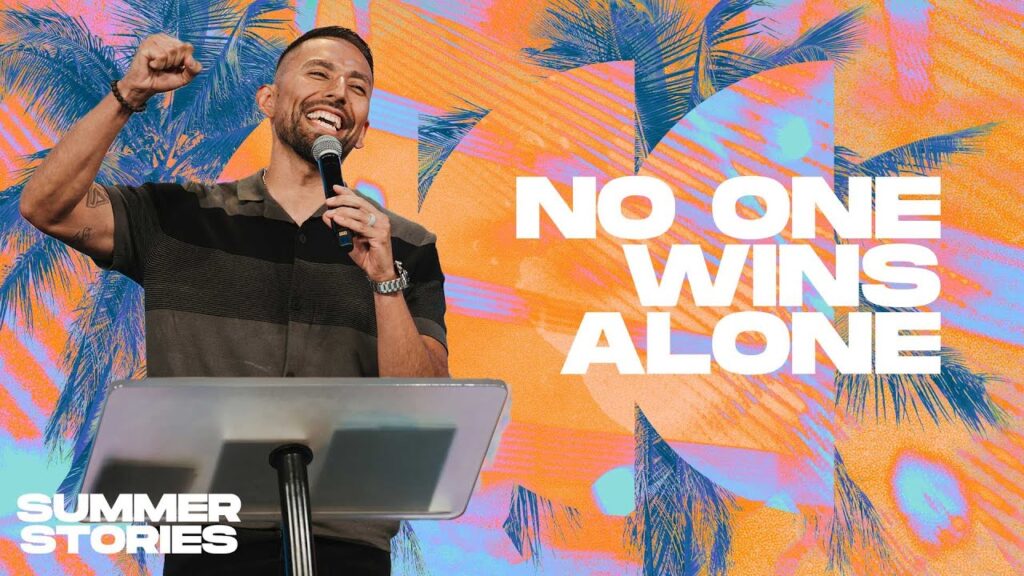
No One Wins Alone
It doesn’t matter how tall, strong, fast, talented or gifted you are, no one wins alone. Whether it be in marriage, parenting, work, friendships, ministry, or just in life, when you do things by yourself, you limit what God can do in your life. In part 3 of our "Summer Stories" series, Pastor Jesse Rodriguez reminds us that no one wins alone.

June 22, 2025
What’s Age Got To Do With It?
Pastor Sheila Gerald kicks off our Summer Stories message series with the story of Samuel and a reminder that you are never too young to hear God's voice. This message, "What's Age Got To Do With It?" discusses how to be in a posture of availability, faithfulness, and closeness to God and it doesn't matter your age to influence others.

July 28, 2024
Summer Stories: Ruth
July 21, 2024
Summer Stories: The Book of Numbers

July 14, 2024
Summer Stories: David & Goliath

July 7, 2024
Summer Stories: Samson

June 30, 2024
Summer Stories: Nehemiah

June 23, 2024
Summer Stories: Deborah